
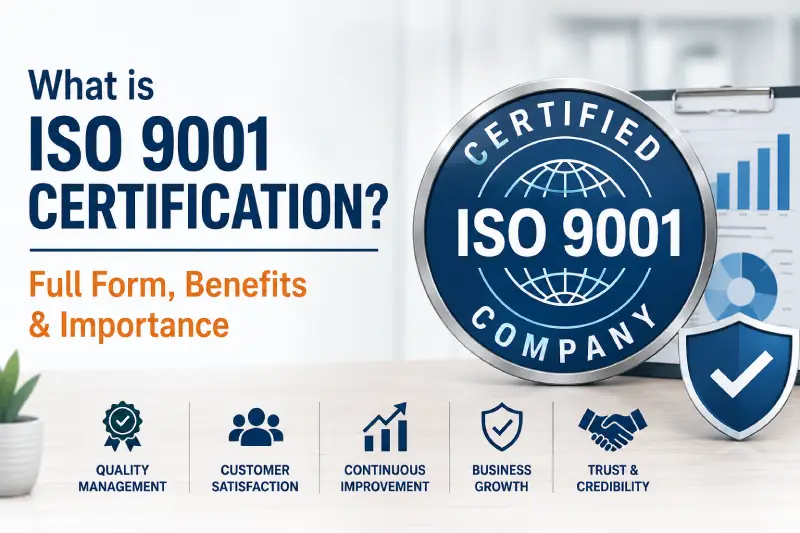
Ever wondered why some businesses consistently deliver top-notch products while others struggle to maintain quality? The secret often lies in a globally recognized standard. If you’ve been looking to elevate your business operations, build customer trust, and streamline your processes, you’ve probably come across the term “ISO 9001.”
But what exactly does it mean for your business? In this guide, we will break down the full form, benefits, and importance of ISO 9001 certification to help you make an informed decision for your company’s future.
What is the Full Form of ISO 9001?
Before diving into the complex details, let’s start with the basics. ISO stands for the International Organization for Standardization.
Interestingly, “ISO” isn’t just an acronym; it is derived from the Greek word isos, which means “equal.” The “9001” refers to the specific standard number dedicated to Quality Management Systems (QMS). Currently, the most up-to-date and widely used version of this standard is ISO 9001:2015.
What is ISO 9001 Certification?
In simple terms, ISO 9001 is a globally recognized standard that outlines the strict requirements for building a robust Quality Management System (QMS). It acts as a strategic framework that ensures your business consistently meets customer expectations while complying with statutory and regulatory requirements.
It is important to note that ISO 9001 does not dictate how you should run your business. Whether you are in manufacturing, IT, hospitality, or healthcare, it provides a flexible blueprint for continuous improvement, minimizing errors, and maximizing operational efficiency.
Why is ISO 9001 Important for Your Business?
Why should business owners care about this certification? Having an ISO 9001 certificate is far more than just a marketing tool. Here is why it is critically important:
- Global Recognition: It acts as a universal badge of quality and trust, making it significantly easier to enter international markets.
- Proactive Risk Management: The framework helps you identify potential risks and operational bottlenecks before they turn into costly customer complaints.
- Regulatory Compliance: It ensures your business is keeping up with the latest industry laws and legal requirements.
- Tender Eligibility: Many government and large corporate contracts strictly require vendors to be ISO 9001 certified just to bid on a project.
Key Benefits of ISO 9001 Certification
Getting certified completely transforms the way your organization operates on a day-to-day basis. Here are the core benefits you will experience:
- Enhanced Customer Satisfaction: By consistently delivering quality products or services, your customer retention and satisfaction rates will naturally soar.
- Increased Operational Efficiency: The standard forces you to document and streamline your processes, which eliminates waste and heavily reduces operational costs.
- Evidence-Based Decision Making: ISO 9001 encourages leadership to make strategic decisions based on hard data and audits rather than guesswork.
- Highly Engaged Employees: Clear processes, structured training, and defined roles mean your team knows exactly what is expected of them, boosting overall morale.
- Competitive Advantage: In a crowded market, having an internationally recognized certification often acts as the deciding factor when a client is choosing between you and a competitor.
Quick Comparison: Your Business With vs. Without ISO 9001
| Business Aspect | Without ISO 9001 | With ISO 9001 Certification |
| Process Efficiency | Unorganized, reactive, and inconsistent. | Streamlined, well-documented, and continuously optimized. |
| Customer Trust | Low to moderate. | High (backed by an international standard). |
| Error & Defect Rate | High; errors are often corrected after the fact. | Low; proactive risk management prevents errors. |
| Market Opportunities | Limited to local or less strict markets. | Open to global markets and government contracts. |
| Employee Clarity | Ambiguous roles leading to confusion. | Clear expectations, structured roles, and accountability. |
How Q Matrix Can Help You Get Certified
We know that navigating the certification process can feel overwhelming. At Q Matrix, we take the stress out of compliance. With over 14 years of experience in the certification industry, we are a leading ISO consultant firm based in Kolkata, helping businesses across the globe.
We don’t just hand you a rulebook. We provide a highly pragmatic approach, focusing on industry best practices that result in continuous growth and profit maximization. From optimal documentation and gap analysis to rigorous training and final audits, Q Matrix ensures end-to-end cooperation so your project is completed on time and in the most cost-effective way possible.
Frequently Asked Questions (FAQs)
1. How much does ISO 9001 certification cost?
The cost of certification varies depending on
• Number of Employees: More employees mean more processes to check. Calculation based on audit days using your total headcount (including remote workers and part-time staff).
• Company Scope Complexity: High-risk industries (e.g., aerospace, medical devices, heavy manufacturing) or environments with complexity.
• Multi-Site Network: Requires longer audit duration.
At Q Matrix, we analyse your specific requirements to provide highly cost-effective and tailored solutions
2. Is ISO 9001 suitable for small businesses and startups?
There are over 20 core Management System Standards (MSS) that are universally recognised as auditable and certifiable. The International Organisation for Standardisation (ISO) has published over 25,000 standards in total, but only those ending in “-1” or classified as “Type A” contain strict requirements that allow for an official audit and certification.
3. What is the ISO 9001 standard?
ISO 9001 is the world’s most recognized standard for Quality Management Systems (QMS). It provides a framework for organizations to ensure their products and services consistently meet customer and regulatory requirements, driving operational efficiency, risk management, and continuous improvement.
Core Principles: The standard is built on several key quality management
Customer Focus: Understanding and exceeding customer needs.
Leadership: Establishing unity of purpose and direction.
Engagement of People: Empowering a competent and dedicated workforce.
Process Approach: Managing activities as interrelated processes.
Continuous Improvement: Operating with an ongoing focus on performance enhancement. Evidence-Based Decision Making: Basing decisions on the analysis of data.