
If you manufacture, import, or distribute industrial and consumer goods in India, you are likely familiar with the iconic ISI mark. You see it stamped on everything from kitchen appliances to the heavy steel used in construction. But how does a business actually obtain this mark? Why is it mandatory for some products while optional for others? And what legal hurdles do you need to avoid?
In this comprehensive guide, we will break down everything you need to know about BIS Certification, its full form, why your business needs it, and the exact step-by-step roadmap to secure your license.
What is BIS Certification? (Full Form & Background)
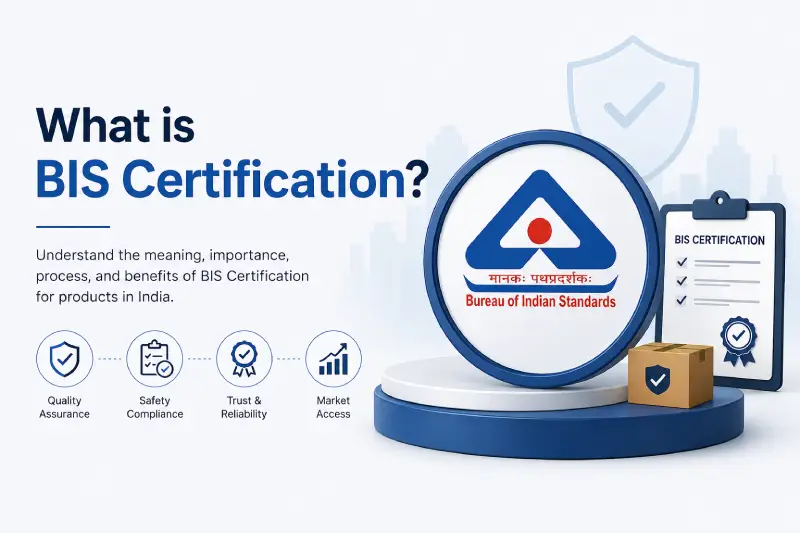
BIS stands for the Bureau of Indian Standards. It is the National Standards Body of India, operating under the aegis of the Ministry of Consumer Affairs, Food & Public Distribution. Its core responsibility is to maintain product quality, consumer safety, and reliability across the Indian market.
Historically, this governing body was established in 1955 under a different name: the Indian Standards Institution (ISI). On January 1, 1987, the institution was restructured and renamed the Bureau of Indian Standards (BIS).
Even though the organization’s name changed, the quality compliance seal itself retained its legacy identity and is still globally recognized as the ISI Mark. When your product features this mark, it serves as undeniable proof that the item conforms to the precise Indian Standards (IS) set by the authorities.
Decoding the Anatomy of an ISI Mark
A genuine ISI mark isn’t just a simple graphic or logo. To comply with official regulations, a valid certification mark on a product must display two highly critical pieces of information:
- The IS Number: Printed directly on top of the ISI mark, this indicates the specific Indian Standard code that the product complies with (for example, IS 694 for specific electrical cables).
- The CM/L License Number: Located at the bottom of the mark, this is a mandatory 7-digit license number formatted as CM/L-xxxxxxx. This unique number is assigned exclusively by BIS to a specific manufacturing unit, making it fully traceable.
Without both the IS number and the 7-digit CM/L code, an ISI mark cannot be legally verified as authentic.
Is BIS Certification Mandatory or Voluntary?
While many brands seek BIS certification voluntarily to give themselves a competitive edge, the Government of India has made it legally mandatory for certain sectors to safeguard public health and environment security. If your product falls under the mandatory category, you cannot legally manufacture, import, or sell it in the Indian market without a license.
Product Categories Under Mandatory Certification:
- Electrical Infrastructure & Appliances: Wiring cables, switches, electric motors, room heaters, and common kitchen appliances.
- Construction Goods: Various types of Portland cement and structural steel.
- Safety Equipment: LPG cylinders, LPG valves, and automotive tyres.
- Consumer Safety Items: Packaged drinking water, milk food formulas, and infant food substitutes.
For items outside these sectors, certification remains optional. However, choosing to get certified helps you stand shoulder-to-shoulder with tier-1 brands.
Commercial Benefits: Why Your Business Needs a BIS License
Going through the certification process is more than just crossing a regulatory hurdle. For a growing business, it unlocks immediate commercial value:
- Builds Instant Market Trust: In the Indian subcontinent, the ISI mark is the ultimate symbol of trust. Consumers buy certified products with complete peace of mind.
- Unlocks Government Tenders: The majority of government contracts, defense procurement setups, and large corporate suppliers strictly mandate that vendors must hold an ISI-marked product catalog.
- Mitigates Legal & Financial Risks: Operating without a required license can lead to heavy penalties, factory closures, and product seizures. Certification guarantees complete legal safety.
- Reduces Manufacturing Defects: Implementing the testing procedures required for a BIS license naturally improves your factory’s internal quality control, leading to less operational waste and fewer customer returns.
Step-by-Step BIS Certification Process
Securing your license requires a systematic blend of documentation, internal preparation, and independent verification. Here is how the process works from start to finish:
Step 1: Identifying the Applicable Indian Standard (IS Code)
Every product has a dedicated standard code. You must first identify the precise IS code that governs your exact product type and variation.
Step 2: Preparing In-House Testing Infrastructure
Before an officer visits your unit, your manufacturing plant must have basic testing facilities set up. This infrastructure is required to show that you can test product quality continuously during daily production lines.
Step 3: Application Assembly & Submission
Compile all required corporate documents, including factory land registration papers, lists of manufacturing machinery, layout blueprints, raw material details, and a step-by-step production flowchart. Once assembled, the formal application is filed with BIS.
Step 4: Factory Audit by a BIS Officer
An appointed BIS official will conduct a physical inspection of your manufacturing facility. They will evaluate your production capabilities, examine your quality control methodologies, and check your testing lab.
Step 5: Sample Extraction & Testing
During the factory audit, the officer will seal random product samples directly from your inventory. These samples are dispatched to an independent, BIS-recognized laboratory for rigorous testing against Indian safety standards.
Step 6: Grant of the CM/L License
Once the laboratory reports confirm that your samples pass all safety metrics, BIS reviews the complete file and issues your unique 7-digit CM/L license number. You are then officially authorized to print the ISI mark on your products.
Streamlining the Compliance Journey
Setting up specialized testing labs, tracking down exact IS codes, and navigating complex corporate paperwork can easily become overwhelming for manufacturers. Minor clerical errors or gaps in your laboratory setups can delay your approval by months, hurting your time-to-market.
At Q Matrix, we eliminate the friction from your compliance journey. Based out of Kolkata and serving businesses nationwide, our specialized team manages the entire process end-to-end. From initial documentation and factory audit preparation to laboratory coordination and final license acquisition, we handle the technical complexities so you can focus entirely on scaling your production.
FAQs
Q1: What is the core difference between BIS and ISI?
Ans: BIS (Bureau of Indian Standards) is the official government organization and regulatory body that reviews and grants certifications. The ISI mark is the actual physical quality seal stamped onto a product to prove it adheres to the standards managed by BIS.
Q2: How can a consumer or business verify if a product’s ISI mark is genuine?
Ans: Every genuine ISI mark contains a 7-digit CM/L license number at the bottom. You can type this number into the official BIS online portal or the “BIS Care” mobile app. A valid number will immediately pull up the manufacturer’s real name, registered factory address, and the specific list of products they are allowed to stamp.
Q3: Can international manufacturers exporting to India get BIS certified?
Ans: Yes. Under the Foreign Manufacturers Certification Scheme (FMCS), overseas manufacturers can apply for a BIS license. This ensures their goods comply with Indian regulations before shipments arrive at Indian customs checkpoints.
Q4: What are the consequences of using a fake ISI mark?
Ans: Misusing the ISI mark or counterfeiting a BIS license is a severe criminal offense under the BIS Act. Violations can result in hefty monetary fines, confiscation of the entire product inventory, and potential imprisonment.
Q5: What is BIS Certification in India?
Ans: It is a government-backed quality and safety stamp managed by the Bureau of Indian Standards. It proves a product meets Indian quality standards and is legally mandatory for items like electronics, steel, chemicals, and cement before they can be sold in India.