
Energy costs are one of the largest operational expenses for businesses across India – whether you run a manufacturing unit in West Bengal, a pharmaceutical company in Gujarat, or a data centre in Bengaluru. Yet most organisations treat energy consumption as a fixed cost, something to manage on spreadsheets rather than through a structured system.
What is ISO 50001?
ISO 50001 is an international standard published by the International Organization for Standardization (ISO) that sets out the requirements for an Energy Management System (EnMS). The current version – ISO 50001:2018 – was updated from the original 2011 edition to align with the High Level Structure (HLS) framework used by other major ISO standards.
In plain terms, it gives organisations a structured, repeatable way to:
- Monitor and measure how energy is being consumed across operations
- Identify where energy is being wasted
- Set clear targets and objectives to reduce that waste
- Act on those targets through documented plans and processes
- Review progress, measure results, and keep improving
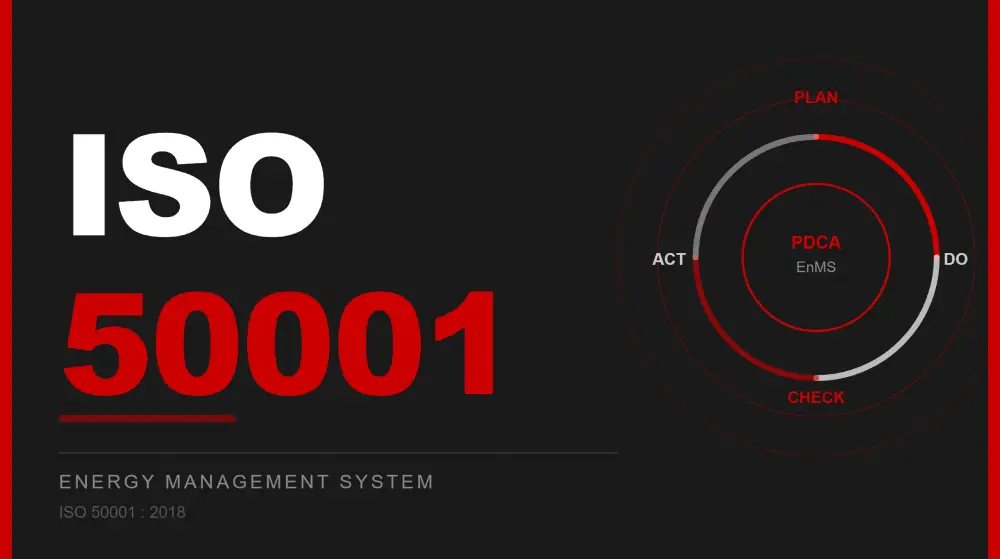
The standard is built on the Plan-Do-Check-Act (PDCA) cycle, the same model used in ISO 9001 (Quality Management) and ISO 14001 (Environmental Management). This is by design, so that organisations already certified under those standards can integrate ISO 50001 without reinventing their management system from scratch.
ISO 50001:2018 vs ISO 50001:2011 – What Changed?
The 2018 revision brought several meaningful changes:
The standard now sits within the HLS framework, meaning its structure, terminology, and core clauses match those of ISO 9001:2015 and ISO 14001:2015. Integration across management systems became much simpler as a result.
Energy performance indicators (EnPIs) and energy baselines (EnBs) received stronger definitions and more rigorous requirements. Organisations must now demonstrate that their EnPIs genuinely reflect energy performance – not just energy consumption data.
Top management involvement became more explicit. Leadership is now required to demonstrate active commitment, not just sign off on a policy document.
The concept of normalisation – adjusting energy data to account for factors like weather, production volume, or occupancy – was clarified and strengthened.
If your organisation holds the 2011 certification, Q Matrix can guide you through the transition audit process efficiently.
Why Does ISO 50001 Matter for Indian Businesses in 2026?
India is the world’s third-largest energy consumer, and both regulatory pressure and market expectations around energy efficiency are rising steadily. Several factors make ISO 50001 directly relevant for Indian organisations right now:
| Factor | Why It Matters |
| BEE / PAT Alignment | Large energy-consuming industries under the PAT scheme can use ISO 50001 as a structured, auditable framework for compliance. |
| Export Market Requirements | Buyers in Europe, Japan, and North America increasingly require supply chain partners to demonstrate energy management credentials. |
| Cost Reduction | Organisations implementing ISO 50001 typically reduce energy consumption by 10% or more within the first certification cycle. |
| ESG Reporting | ISO 50001 creates the internal data infrastructure needed to support credible Scope 1 and Scope 2 emissions disclosures. |
| Tendering Advantage | Government and corporate tenders increasingly score suppliers on sustainability credentials. ISO 50001 is a differentiator. |
Which Industries Benefit Most from ISO 50001 Certification?
Q Matrix has worked with organisations across a wide range of sectors. The standard applies to any organisation that uses energy – regardless of size, type, or geography. The return on investment is highest in energy-intensive operations.
- Manufacturing – steel, cement, paper, glass, chemicals, plastics, textiles, and auto components
- Energy and Solar – power generation, solar project development, and energy distribution
- Food and FMCG – cold storage, refrigeration, and processing lines
- Information Technology and Data Centres – cooling systems account for up to 40% of total energy spend
- Pharmaceutical – cleanrooms, HVAC systems, and sterilisation equipment
- Construction and Real Estate – commercial buildings, hotel chains, and campuses
- Transport and Logistics – fleet fuel consumption and warehouse energy use
- Hospitality – kitchens, HVAC, laundry, and guest room energy systems
Core Requirements of ISO 50001:2018 – Clause by Clause
ISO 50001:2018 is structured around ten clauses, with the normative requirements beginning at Clause 4.
| Clause | Requirement Summary |
| Clause 4 – Context | Identify internal/external factors, define EnMS scope and boundaries, understand interested parties. |
| Clause 5 – Leadership | Top management must establish an energy policy, assign roles, and integrate energy performance into strategic planning. |
| Clause 6 – Planning | Conduct an energy review, identify Significant Energy Uses (SEUs), establish energy baselines (EnBs) and performance indicators (EnPIs), set objectives and action plans. |
| Clause 7 – Support | Competence, awareness, training, communication, and documentation. People responsible for SEUs must be trained. |
| Clause 8 – Operation | Operate SEUs under controlled conditions. Consider energy performance in design and procurement. |
| Clause 9 – Performance Evaluation | Monitor and measure energy performance. Conduct internal audits and management reviews at planned intervals. |
| Clause 10 – Improvement | Identify and correct nonconformities. Root cause analysis and corrective actions. Continual improvement of energy performance. |
The ISO 50001 Certification Process – Step by Step
Here is how the certification process works, in the sequence Q Matrix follows with our clients:
Step 1 – Initial Enquiry and Scope Discussion
We understand your industry, operations, energy sources, approximate energy consumption, and existing management system maturity. We explain scope options and cost structure transparently.
Step 2 – Gap Analysis
Our consultants assess your current practices against ISO 50001:2018 requirements. The gap analysis report tells you exactly what is already in place, what needs to be developed, and how long implementation will realistically take.
Step 3 – Energy Review and Baseline Establishment
We work with your team to map energy sources (electricity, gas, diesel, steam), identify SEUs, collect historical consumption data, and establish baselines and EnPIs.
Step 4 – Documentation and System Development
We develop all required documentation – energy policy, procedures, objectives, action plans, monitoring formats, and audit checklists – customised to your operations, not generic templates.
Step 5 – Implementation Support
We support your team through implementation – training relevant personnel, setting up monitoring systems, and reviewing early data to ensure the EnMS is functioning as designed.
Step 6 – Internal Audit
Before the certification body arrives, we conduct a thorough internal audit. Nonconformities are identified and corrected. This significantly reduces the risk of major findings during the Stage 2 certification audit.
Step 7 – Certification Body Audit
The accredited certification body conducts a Stage 1 (document review) and Stage 2 (on-site) audit. Q Matrix coordinates throughout and supports your team.
Step 8 – Certificate Issuance
On successful completion, your ISO 50001:2018 certificate is issued. Surveillance audits are conducted annually, with recertification every three years.
ISO 50001 and Integration with Other ISO Standards
One of the most practical aspects of ISO 50001:2018 is how naturally it fits alongside other certifications your organisation may already hold.
| Combination | Benefit |
| ISO 50001 + ISO 14001 | Most common combination. Creates a comprehensive environmental and energy management system. Q Matrix holds expertise in both. |
| ISO 50001 + ISO 9001 | Quality-focused manufacturers find ISO 50001 a logical extension. PDCA structure, documentation, and management review can be consolidated. |
| ISO 50001 + ISO 45001 | Integrated system covering safety, environment, and energy – HSSE management – for large industrial facilities. |
| ISO 50001 + ISO 13485 | Pharma and medical device companies managing energy costs alongside quality and regulatory compliance frameworks. |
At Q Matrix, we specialise in integrated management system design – reducing documentation burden, audit fatigue, and training requirements by building a single coherent system rather than isolated silos.
Why Choose Q Matrix for ISO 50001 Certification?
Q Matrix Consultancy Services has been operating for over 14 years from Kolkata, serving clients across India in sectors ranging from manufacturing and food processing to IT and pharma. Our approach to ISO 50001 is practical, not theoretical.
We do not hand you a folder of generic templates and tell you to implement them. We sit with your team, understand your energy landscape, and build an EnMS that actually works for your organisation – one that reduces real energy costs and stands up to audit scrutiny.
Our consultants carry hands-on industry experience alongside their ISO expertise. We have supported organisations through PAT compliance, integrated EnMS implementations, transition audits from ISO 50001:2011 to 2018, and multi-site certification programmes.
Beyond ISO 50001, Q Matrix offers the full spectrum of ISO certifications – ISO 9001, ISO 14001, ISO 45001, ISO 27001, ISO 22000, and many more – which means we can design an integrated management system that grows with your organisation.
FAQs
Is ISO 50001 mandatory in India?
It is not legally mandatory for most organisations. However, for companies under the BEE’s PAT scheme, ISO 50001 is strongly aligned with compliance obligations. In many export-facing industries, it is becoming a commercial necessity rather than a choice.
How long does it take to get certified?
For most organisations, the implementation and certification process takes between three to six months from engagement to certificate issuance. The timeline depends on the complexity of your operations and the maturity of your existing management systems.
How much does ISO 50001 certification cost?
The cost depends on organisation size, number of sites, energy complexity, and the certification body selected. Q Matrix provides a transparent, competitive fee structure with no hidden costs. Fill in the consultation form on our website to get a tailored estimate.
Do we need a dedicated energy manager?
No. ISO 50001 requires that roles and responsibilities be defined, but it does not require a full-time dedicated energy manager. Many of our clients designate an existing person – a facilities manager, maintenance head, or sustainability lead – as the management representative for the EnMS.
What happens if we fail the certification audit?
Major nonconformities require corrective action within a defined period before the certificate is issued. Q Matrix’s pre-audit preparation work is specifically designed to ensure this situation does not arise. In our experience across 14 years of consultancy, well-prepared clients pass their certification audits.