
Think about how much sensitive information your business handles every day. Customer records. Financial data. Employee files. Business contracts. Internal communications. Now ask yourself — if any of that were stolen, leaked, or compromised tomorrow, what would happen to your business?
For most organizations, the answer is uncomfortable. Data breaches don’t just cost money — they cost client trust, contracts, and sometimes the business itself. And in 2026, with cyberattacks growing more sophisticated by the month, the question isn’t whether your data is at risk. It’s whether you have a system strong enough to protect it.
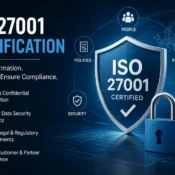
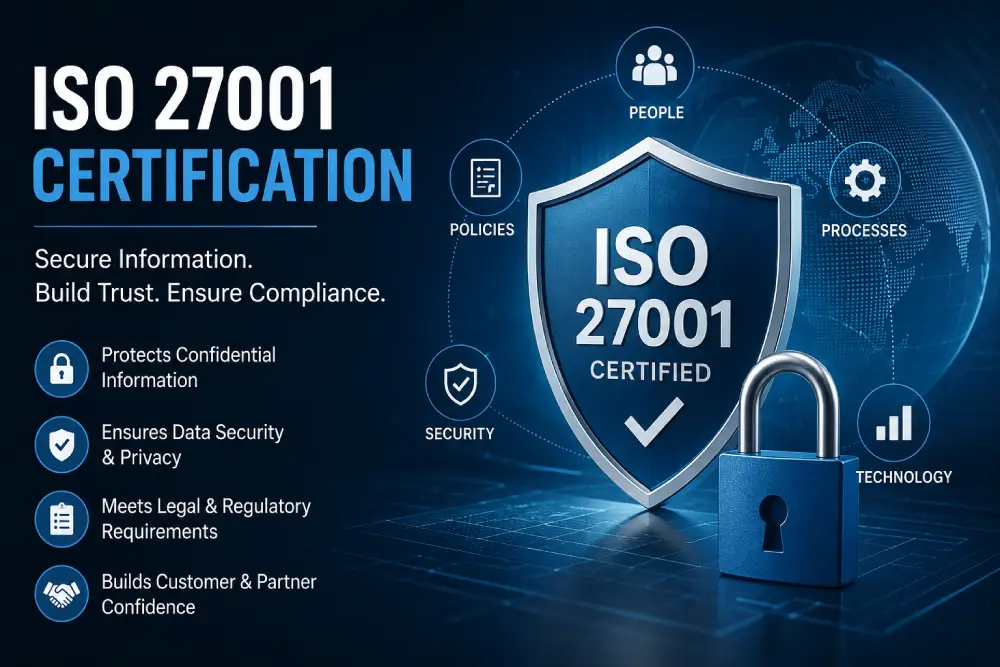
ISO 27001 is that system. It’s the world’s most recognized standard for Information Security Management — and at Q Matrix Consultancy Services, we’ve been helping businesses across India implement and achieve ISO 27001 certification for over 14 years. This guide explains everything you need to know, plainly and practically.
What is ISO 27001 Certification?
ISO 27001 is an international standard published by the International Organization for Standardization (ISO) that defines the requirements for an Information Security Management System — commonly called an ISMS.
The current version, ISO 27001:2022, was updated from the 2013 edition to reflect today’s threat landscape — including cloud security, remote work risks, and supply chain vulnerabilities. It gives your organization a structured, risk-based framework to:
- Identify what information assets your organization holds and why they matter
- Assess threats and vulnerabilities that could compromise those assets
- Implement the right security controls — technical, physical, and organizational
- Monitor, review, and continuously improve your information security posture
- Demonstrate to clients, auditors, and regulators that your data practices are trustworthy
ISO 27001 applies to any organization that handles information — IT companies, banks, hospitals,
manufacturers, BPOs, government contractors, and any business that holds client or employee data.
If information matters to your business, ISO 27001 is relevant.
ISO 27001:2013 vs ISO 27001:2022 — What Changed?
If your organization holds a certification to ISO 27001:2013, you should know that the transition deadline to the 2022 version was October 2026. Certificates based on the old version are no longer valid.
Here’s what changed in the 2022 update:
Annex A Controls Restructured
The 114 controls in ISO 27001:2013 were reorganized into 93 controls across 4 themes — Organizational, People, Physical, and Technological. Eleven new controls were added, covering areas like threat intelligence, cloud security, data masking, and secure coding.
Stronger Emphasis on Risk-Based Thinking
The 2022 version places even greater emphasis on identifying and treating risks proactively — not just documenting policies and hoping for the best.
Better Alignment with Other ISO Standards
The updated structure aligns more cleanly with ISO 9001, ISO 14001, and ISO 45001 — making integration into a combined management system more straightforward.
If you were certified under ISO 27001:2013 and haven’t yet transitioned to the 2022 version,
contact Q Matrix immediately. We’ll assess your current system and manage the transition efficiently.
Why ISO 27001 Matters for Your Business in 2026
Data breaches are no longer rare events
India saw a sharp rise in cyberattacks across sectors in 2023 and 2024 — targeting everything from hospital patient records to financial services data. ISO 27001 gives your organization a proactive, tested defense framework rather than waiting to react after something goes wrong.
Clients and enterprise buyers now require it
If you’re a vendor, supplier, or service provider to any mid-to-large organization — especially in IT, BFSI, healthcare, or government — expect to be asked for ISO 27001 certification as a condition of onboarding or contract renewal. It’s no longer a differentiator. For many buyers, it’s a minimum requirement.
Regulatory pressure is increasing
India’s Digital Personal Data Protection Act (DPDPA) 2023 places clear obligations on organizations to protect personal data. While ISO 27001 isn’t mandated by the DPDPA, having a certified ISMS is one of the strongest ways to demonstrate compliance readiness — and defend against regulatory action if a breach occurs.
It protects more than data — it protects your reputation
A single breach headline can undo years of brand-building. ISO 27001 isn’t just a technical exercise — it’s a visible signal to clients, partners, investors, and employees that you take information security seriously enough to have it independently verified.
Remote work and cloud adoption have expanded the attack surface
Hybrid work models and cloud-first IT strategies have made the old ‘perimeter security’ approach obsolete. ISO 27001:2022 specifically addresses these realities — covering cloud security, remote access controls, and supplier risk management.
What Does an ISO 27001 ISMS Actually Cover?
An Information Security Management System isn’t just an IT security system — it covers the full spectrum of how your organization handles information:
- Physical security — who has physical access to offices, server rooms, and equipment
- Access controls — who can access what systems, applications, and data, and under what conditions
- Incident response — what happens when a security event occurs, and how fast
- Supplier and third-party risk — how you manage data shared with vendors, partners, and cloud providers
- Business continuity — how the organization maintains critical operations after a security incident
- Employee awareness — training people to recognize phishing, social engineering, and safe data practices
- Legal and regulatory compliance — mapping your security controls to applicable laws and contracts
- Continuous improvement — regular audits, reviews, and updates to keep the ISMS current
This breadth is exactly why ISO 27001 is trusted globally — it treats information security as a business-wide discipline, not just an IT department problem.
How to Get ISO 27001 Certified — Step by Step
Here’s exactly how Q Matrix guides your organization from start to certified:
- Gap Analysis — We audit your current information security practices against ISO 27001:2022 requirements and identify exactly what needs to be built or strengthened
- Risk Assessment — We help you identify your information assets, evaluate threats and vulnerabilities, and determine the appropriate controls
- ISMS Documentation — We develop your Information Security Policy, risk treatment plan, Statement of Applicability (SoA), procedures, and all required records
- Implementation Support — We work with your team to embed the ISMS into real operations — not just on paper
- Internal Audit — We conduct a thorough internal audit to find and fix any gaps before the certification body arrives
- Certification Audit — An accredited third-party certification body conducts Stage 1 (documentation review) and Stage 2 (on-site implementation audit)
- Certificate Issued + Ongoing Surveillance — Your ISO 27001:2022 certificate is valid for 3 years, with annual surveillance audits. Q Matrix supports all of these
Timeline: Most organizations complete the process in 3 to 6 months.
IT companies and smaller organizations often certify in as little as 2 to 3 months.
Q Matrix has guided organizations of all sizes through this process — including first-time certifications
and transitions from ISO 27001:2013 to the current 2022 version.
Which Industries Need ISO 27001?
While ISO 27001 is relevant to any organization handling sensitive information, these sectors face the highest pressure — from clients, regulators, and the nature of the data they hold:
- Information Technology & Software — Client data, IP, source code, cloud infrastructure
- BFSI (Banking, Financial Services, Insurance) — Transaction data, KYC records, financial information
- Healthcare & Pharma — Patient records, clinical trial data, regulatory filings
- BPO / KPO / Outsourcing — Processing data on behalf of third-party clients
- E-commerce & Retail — Customer PII, payment card data, purchase history
- Telecom — Call records, subscriber data, network infrastructure
- Government Contractors & Defence Suppliers — Classified and sensitive project data
- Legal & Professional Services — Client confidentiality, privileged communications
- Manufacturing (with IP) — Designs, formulations, supply chain data
Q Matrix has helped organizations across all of these sectors achieve ISO 27001 certification — across all Indian states, from Kolkata to Kochi to Chandigarh.
Why Choose Q Matrix for ISO 27001?
With 14+ years of experience, Q Matrix is one of India’s most trusted ISO certification consultancies. Here’s what makes us different:
- Deep ISMS expertise – We’ve implemented ISO 27001 across IT companies, BPOs, manufacturers, and healthcare organizations
- Current with ISO 27001:2022 – Our methodology is fully updated to the latest version, including the 11 new controls
- End-to-end support – From gap analysis and documentation to internal audit and post-certification surveillance
- Pan-India presence – We serve clients across all Indian states, in-person and remotely
- Related standards expertise – We also handle ISO 27701 (Privacy), ISO 27017 (Cloud Security), and ISO 20000-1 (IT Service Management), which are natural companions to ISO 27001
- 100% customer satisfaction – Your certification is our commitment, not just our service
Frequently Asked Questions About ISO 27001 Certification
Q1. What is the difference between ISO 27001 and ISO 27002?
ISO 27001 is the certifiable standard – it defines the requirements your organization must meet to have a certified ISMS. ISO 27002 is a guidance document that provides best-practice details on how to implement each of the Annex A security controls. You get certified to ISO 27001; you use ISO 27002 as a reference for implementation. Both are complementary – ISO 27001 is the ‘what’, ISO 27002 is the ‘how’.
Q2. How long does ISO 27001 certification take in India?
For most small to mid-sized organizations, the process takes 3 to 6 months from gap analysis to certificate. IT companies with existing security practices sometimes certify faster — in 2 to 3 months. Larger organizations or those with complex multi-site operations may take 6 to 9 months. Q Matrix works to your timeline and has successfully guided both fast-track and phased implementations.
Q3. Is ISO 27001 mandatory for businesses in India?
ISO 27001 is not legally mandated for most businesses under current Indian law. However, it is increasingly required in practice — by enterprise clients during vendor onboarding, by government procurement processes, by international buyers, and by companies handling personal data under India’s Digital Personal Data Protection Act (DPDPA) 2023. For IT companies, BPOs, and anyone processing third-party data, it is effectively becoming a market requirement.
Q4. What is the Statement of Applicability (SoA) in ISO 27001?
The Statement of Applicability is one of the most important documents in your ISMS. It lists all 93 controls from ISO 27001:2022 Annex A, states which ones are applicable to your organization, which are excluded (and why), and how each applicable control has been implemented. It’s essentially your organization’s tailored security control register — and it’s a mandatory document for certification. Q Matrix prepares a complete, auditor-ready SoA as part of our standard engagement.
Q5. Can ISO 27001 be integrated with ISO 9001 or ISO 45001?
Yes — and many organizations find this very cost-effective. ISO 27001, ISO 9001 (Quality), ISO 14001 (Environment), and ISO 45001 (Occupational Health & Safety) all share the same High-Level Structure (HLS). This means their core frameworks — context, leadership, planning, support, operation, evaluation, and improvement — are identical. Q Matrix builds Integrated Management Systems (IMS) that combine two or more standards into a single, unified system — reducing documentation, audit effort, and overall cost significantly.
Start Your ISO 27001 Journey Today
Information security isn’t something you can afford to treat as an afterthought anymore. Whether you’re looking to win a new enterprise client, protect your business from a growing threat landscape, or demonstrate compliance with India’s data protection regulations — ISO 27001 certification is the clearest, most credible signal you can send. Q Matrix makes the entire process practical, affordable, and genuinely useful — not just a documentation exercise that gathers dust on a shelf.