
If you manufacture, assemble, sterilize, distribute, or service medical devices – or even supply components and support services to companies that do – you’ve probably run into the term ISO 13485 more than once. Buyers ask for it in RFPs. Regulators reference it. Export markets often won’t touch your product without it.
But what does the certificate actually cover, who really needs it, and what does getting one involve? This guide walks through the standard in plain terms, with a focus on how it applies to Indian manufacturers selling both domestically and abroad.
What Is ISO 13485 Certification?
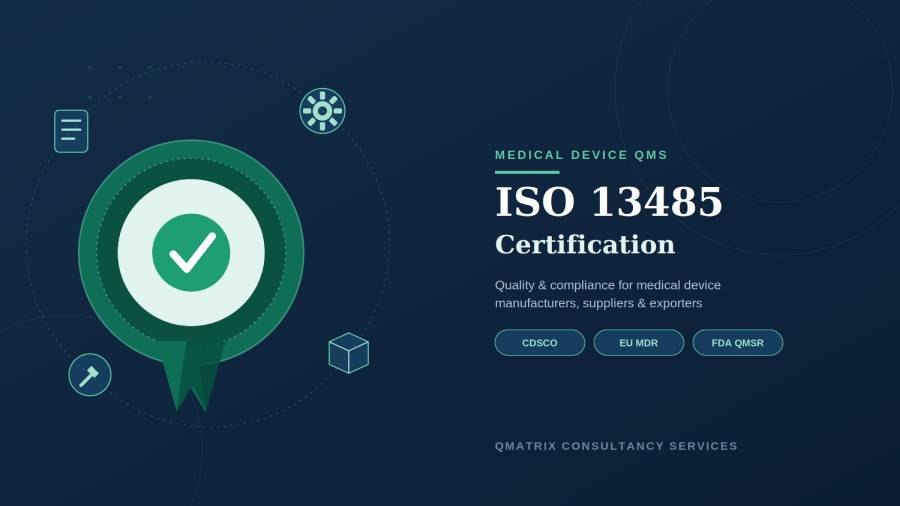
ISO 13485:2016 is the international standard for a Quality Management System (QMS) specific to the medical device industry. Unlike the more general ISO 9001, it’s built entirely around the risks, regulatory obligations, and lifecycle stages unique to medical devices – design and development, production, storage, distribution, installation, and servicing.
The certificate tells a regulator, buyer, or hospital procurement team one thing: your organization has a documented, auditable system for consistently controlling quality and safety at every stage your product passes through. It doesn’t certify the device itself – it certifies the system that produces, tests, and releases the device.
Any organization involved in even one stage of a device’s lifecycle can pursue certification. That includes contract manufacturers, component suppliers, packaging and labelling companies, calibration service providers, and software developers building medical device software.
Why Does ISO 13485 Certification Matter for Medical Device Companies?
Three reasons come up again and again with clients:
Market access. Most regulatory frameworks either require or strongly favour ISO 13485-certified suppliers. The EU Medical Device Regulation (MDR) requires it for CE marking of most device classes. Health Canada mandates it under the Canadian Medical Devices Conformity Assessment System (CMDCAS/MDSAP). Australia’s TGA, several Southeast Asian regulators, and increasingly the Gulf markets all lean on it as evidence of a controlled QMS.
The FDA shift changes the calculation for US-bound exporters. As of February 2, 2026, the FDA’s new Quality Management System Regulation (QMSR) formally replaced the old 21 CFR 820 Quality System Regulation and incorporated ISO 13485:2016 by reference. In practical terms, US market access now runs on the same quality-system backbone as the rest of the world. If you’re exporting to the US, having ISO 13485 in place is no longer just a competitive edge – it’s close to a prerequisite for a smooth QMSR transition.
Buyer and hospital trust. Large OEMs and hospital procurement departments increasingly won’t onboard a new vendor without it, regardless of what the regulator technically requires. It’s become a baseline commercial expectation, not just a regulatory checkbox.
Is ISO 13485 Certification Mandatory in India?
Not by law, in most cases. India’s medical device regulator, the CDSCO (Central Drugs Standard Control Organisation), operates under the Medical Device Rules, 2017, which sets out its own licensing requirements for manufacturing and sale within India – separate from ISO 13485.
That said, in practice, ISO 13485 certification is treated as strong supporting evidence during CDSCO manufacturing licence applications, and it’s frequently a contractual requirement even when it isn’t a legal one. If any part of your business touches export markets, hospital tenders, or OEM supply chains, certification tends to become a practical necessity fairly quickly, even where the law itself doesn’t demand it.
Who Actually Needs This Certification?
ISO 13485 applies more broadly than most people expect. You should be considering it if you are:
- A medical device manufacturer (Class A, B, C, or D under Indian classification)
- A contract manufacturer or OEM producing devices on behalf of a brand owner
- A supplier of critical components, raw materials, or sub-assemblies used in devices
- A provider of sterilization, calibration, packaging, or labelling services for devices
- A distributor or importer responsible for storage, handling, and traceability
- A developer of standalone medical device software (SaMD)
- A servicing or installation provider for diagnostic or therapeutic equipment
If your organization sits anywhere in this chain and your customers are asking about your quality system, that’s usually the signal it’s time to move forward.
What Does the ISO 13485 Certification Process Look Like?
The path is fairly standard across certification bodies, though the depth of work at each stage depends on how mature your existing processes already are.
- Gap assessment. A review of your current processes against ISO 13485 clauses to identify what’s missing – documentation, risk management records, design controls, traceability systems, and so on.
- QMS design and documentation. Building or revising your quality manual, SOPs, work instructions, risk management files (usually aligned with ISO 14971), and device master records.
- Implementation and internal audit. Rolling the system out across departments, training staff, and running internal audits to catch gaps before the certification body does.
- Management review. Top management formally reviews QMS performance, audit findings, and corrective actions – a mandatory clause under the standard.
- Certification audit, Stage 1. The certification body reviews your documentation and readiness.
- Certification audit, Stage 2. An on-site (or remote, where permitted) audit verifying that the system is actually operating as documented, with objective evidence.
- Certificate issuance. Once non-conformities, if any, are closed out, the certificate is issued – typically valid for three years, with mandatory surveillance audits each year to maintain it.
How Long Does ISO 13485 Certification Take?
For a company with no existing formal QMS, the realistic timeline is usually somewhere between 3 and 6 months, depending on the size of the organization, the number of product lines and locations, and how quickly documentation and internal audits can be completed. Companies that already run a mature ISO 9001 system tend to move faster, since a fair amount of the documentation structure and audit discipline carries over.
Rushing this process rarely ends well – most delays at the audit stage come from incomplete design history files, missing risk management documentation, or gaps in CAPA (corrective and preventive action) records, all of which are avoidable with proper groundwork before the certification audit is scheduled.
What Does ISO 13485 Certification Cost?
Certification cost isn’t a flat number – it depends on your headcount, number of sites, product complexity, and whether you’re starting from scratch or upgrading an existing QMS. Broadly, the cost sits across three buckets:
- Consulting and implementation support (gap analysis, documentation, training, internal audits)
- Certification body audit fees (Stage 1 and Stage 2 audits, based on man-days required)
- Ongoing costs (annual surveillance audits and the recertification audit every three years)
Rather than quoting a single figure that won’t apply to most readers, the honest answer is: get a scoped quote based on your actual site count, employee strength, and product classification. A single-site company with one product line will pay considerably less than a multi-site manufacturer with several device classes and export markets to satisfy.
Frequently Asked Questions
What is ISO 13485 Certification?
ISO 13485 Certification confirms that a medical device organization has a documented, independently audited Quality Management System covering design, production, storage, distribution, installation, or servicing of medical devices. It’s issued by an accredited certification body after the organization demonstrates compliance with the ISO 13485:2016 standard through a two-stage audit process.
Why is ISO 13485 Certification important for medical device manufacturers?
It signals regulatory readiness and risk control to everyone in the supply chain – notified bodies, national regulators, hospital procurement teams, and OEM customers. Practically, it supports CE marking under the EU MDR, aligns with the FDA’s QMSR (effective February 2, 2026), and is often treated as supporting evidence during CDSCO licensing in India. Without it, many export markets and large buyers simply won’t engage.
Who needs ISO 13485 Certification?
Any organization involved in a medical device’s lifecycle: manufacturers and OEMs, contract manufacturers, component and raw material suppliers, sterilization and calibration service providers, packaging and labelling companies, distributors and importers, medical device software developers, and equipment servicing or installation providers. If your customers are asking about your quality system, that’s usually the sign you need it.
What are the key requirements of ISO 13485 Certification?
The standard centres on a handful of core areas: a documented quality management system with defined processes and records, top management commitment and regular management reviews, risk management aligned with ISO 14971, design and development controls, supplier and purchasing controls, product traceability, complaint handling and post-market surveillance, CAPA (corrective and preventive action) processes, and internal audits conducted on a planned schedule. Auditors expect to see all of this operating as documented, not just written down.
How can a company obtain ISO 13485 Certification?
Start with a gap assessment against the standard, then build or update your QMS documentation, implement it across the organization, and run internal audits and a management review to confirm readiness. From there, an accredited certification body conducts a Stage 1 documentation review followed by a Stage 2 on-site audit. Once any non-conformities are closed out, the certificate is issued – valid for three years, with annual surveillance audits to maintain it.
Getting Started with ISO 13485 Certification
Whether you’re preparing for a CDSCO licence, gearing up for EU or US market entry, or simply responding to a buyer’s tender requirement, the process goes more smoothly with an accurate gap assessment before you commit to a timeline. Q Matrix Consultancy Services works with medical device manufacturers, component suppliers, and service providers across India on ISO 13485:2016 implementation and certification support, from documentation through to audit readiness. Get in touch with Q Matrix to scope out where your organization stands and what certification would realistically involve.