
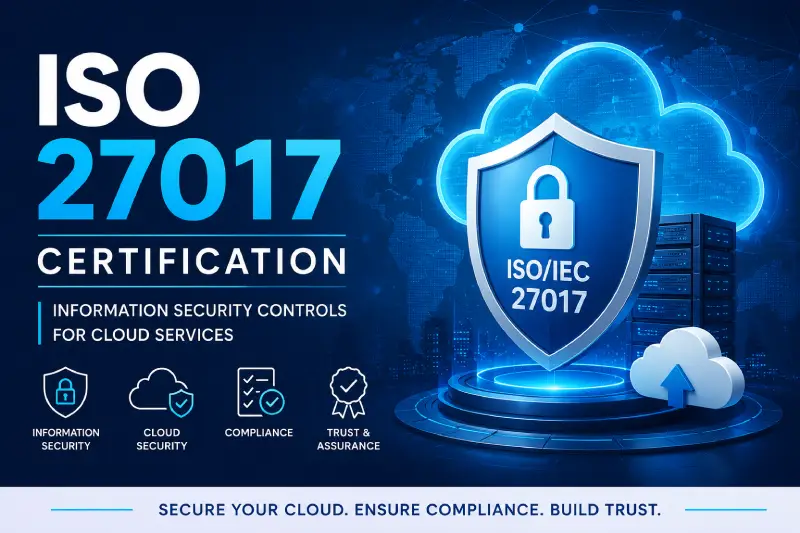
Cloud computing has changed how businesses operate – and most of the time, that’s a good thing. Faster deployment, lower infrastructure costs, better scalability, the ability to work from anywhere. The benefits are real and significant. But as more organisations in India move critical data and operations to the cloud, one question becomes impossible to ignore: who is actually responsible for keeping that data secure? That’s precisely where ISO 27017 certification comes in.
But here’s what often gets overlooked: when you move your data and operations to the cloud, you’re sharing responsibility for security with your cloud service provider. And unless both sides are clear on who protects what, things can slip through the gaps.
That’s exactly the problem ISO 27017 was designed to solve. It’s the international standard specifically built for cloud security – providing a shared framework that cloud service providers and their customers can both follow. And if your organisation uses cloud services in any meaningful way, understanding ISO 27017 is worth your time.
Q Matrix Consultancy Services has spent over 14 years working with organisations across India on information security certifications. This guide explains ISO 27017 clearly – what it is, why it matters, and how to implement it.
What is ISO 27017?
ISO/IEC 27017:2015 is an international standard published jointly by the International Organization for Standardization (ISO) and the International Electrotechnical Commission (IEC). Its full title is ‘Information Technology – Security Techniques – Code of Practice for Information Security Controls Based on ISO/IEC 27002 for Cloud Services.’
In plain language: it’s a set of guidelines for securing cloud environments – written specifically for both cloud service providers (the companies that run cloud platforms) and cloud service customers (the organisations that use those platforms to store data and run applications).
ISO 27017 does two things:
- It provides additional implementation guidance for 37 existing controls from ISO 27002 – explaining how those controls apply specifically in cloud environments
- It introduces 7 brand-new cloud-specific controls that don’t exist anywhere in ISO 27001 or ISO 27002
ISO 27017 is not a standalone certification standard in the traditional sense.
It is a code of practice – a guidance document that is implemented alongside ISO 27001.
Organisations implement ISO 27017 controls as an extension of their ISO 27001 ISMS,
and third-party certification is available for both cloud providers and cloud customers.
The 7 New Cloud-Specific Controls in ISO 27017
These seven controls are unique to ISO 27017 – they exist because the cloud introduces security considerations that simply don’t apply to traditional on-premise IT environments:
1. Shared Roles and Responsibilities
Who is responsible for which security controls – the cloud provider or the customer? ISO 27017 requires that this is explicitly documented and agreed upon between both parties. This is the ‘shared responsibility model’ made formal and contractual.
2. Removal and Return of Assets
What happens to your data when a cloud service contract ends? ISO 27017 requires clear procedures for the return, deletion, or destruction of customer assets when the relationship terminates – ensuring no data lingers in the provider’s environment.
3. Protection and Separation of Virtual Environments
In a cloud environment, multiple customers share the same physical infrastructure. ISO 27017 requires cloud providers to implement proper isolation between customer virtual environments – so one customer’s data cannot be accessed by another.
4. Virtual Machine Hardening
Virtual machines (VMs) must be secured and configured to a minimum baseline security standard. Both providers and customers have responsibilities here – providers for the underlying platform, customers for the VMs they deploy and manage.
5. Administrative Operations in the Cloud
Cloud environments require administrative access that carries significant security risk. ISO 27017 requires that administrative procedures be documented, monitored, and controlled – with appropriate access restrictions and audit logging.
6. Monitoring of Cloud Services
Customers must have the ability to monitor their own activities within the cloud environment. ISO 27017 requires cloud providers to give customers adequate monitoring tools and logs to detect security incidents within their cloud usage.
7. Virtual and Cloud Network Environments
Networks in cloud environments are fundamentally different from physical networks. ISO 27017 requires that network security controls in virtual environments are equivalent in effectiveness to those used in traditional physical network environments.
ISO 27017 vs ISO 27001 vs ISO 27002 – What’s the Difference?
These three standards are closely related and often confused. Here’s a clear breakdown:
ISO 27001 – The Foundation
ISO 27001 is the certifiable standard for Information Security Management Systems (ISMS). It defines the requirements your organisation must meet and the controls you must implement. It’s the standard you get certified to.
ISO 27002 – The Control Library
ISO 27002 is a guidance document that provides detailed implementation advice for the 93 security controls referenced in ISO 27001 Annex A. It explains HOW to implement the controls, but organisations don’t get certified to ISO 27002 directly.
ISO 27017 – The Cloud Layer
ISO 27017 sits on top of ISO 27002. It takes 37 of those controls and provides additional, cloud-specific implementation guidance. It then adds 7 new controls that are unique to cloud environments. Think of it as the cloud security supplement to your existing ISO 27001 ISMS.
The practical implication: to properly implement ISO 27017, your organisation
should already have or be working toward ISO 27001 certification.
ISO 27017 extends and strengthens your ISMS for cloud-specific risks –
it doesn’t replace the foundation that ISO 27001 provides.
Why ISO 27017 Matters for Your Business in 2026
Cloud adoption has made security responsibility more complex
A decade ago, most businesses kept their data on their own servers. Security was relatively straightforward: protect the perimeter. Today, data lives across multiple cloud platforms – AWS, Azure, Google Cloud, SaaS applications – each with their own security models. ISO 27017 provides a common framework to manage security across this complex landscape.
Regulatory expectations are increasing
India’s Digital Personal Data Protection Act (DPDPA) 2023 places clear obligations on organisations that process personal data in the cloud. ISO 27017 provides a structured, internationally recognised approach to meeting those obligations – particularly around data handling, access controls, and incident management.
Enterprise and government clients expect it
If your organisation provides cloud-based services to enterprise clients – particularly in BFSI, healthcare, government, or regulated industries – expect to be asked about your cloud security posture. ISO 27017 implementation, particularly alongside ISO 27001, is a credible, third-party verified answer to that question.
It builds genuine trust with your cloud customers
For cloud service providers, ISO 27017 certification sends a clear message to prospective customers: we’ve had our cloud security controls independently verified against an internationally recognised standard. In a market where cloud security incidents make headlines regularly, that trust signal is genuinely valuable.
It fills the gaps that ISO 27001 alone doesn’t cover
ISO 27001 is a comprehensive standard – but it was designed before cloud computing became the norm. ISO 27017 fills the specific gaps that cloud environments create: virtual machine security, multi-tenancy, provider-customer responsibility boundaries, and cloud-specific monitoring. Without it, your ISMS may have blind spots.
Who Should Implement ISO 27017?
ISO 27017 is relevant to two distinct groups – and both are increasingly under pressure to address cloud security formally:
Cloud Service Providers (CSPs)
- SaaS, PaaS, and IaaS providers offering cloud-based services
- Data centre operators hosting cloud infrastructure
- Managed service providers (MSPs) delivering cloud-based managed services
- Software companies with multi-tenant cloud applications
Cloud Service Customers (CSCs)
- IT companies using AWS, Azure, Google Cloud, or similar platforms
- BFSI organisations storing customer data in cloud environments
- Healthcare providers using cloud for patient records and clinical systems
- BPO and KPO companies processing client data on cloud platforms
- E-commerce companies running operations on cloud infrastructure
- Any organisation using SaaS tools (Microsoft 365, Salesforce, etc.) for business-critical data
In short: if your business either provides cloud services or uses them to process sensitive data, ISO 27017 is relevant to you.
How to Implement ISO 27017 – The Q Matrix Approach
At Q Matrix, we guide organisations through ISO 27017 implementation as part of a comprehensive cloud security programme:
- Current State Assessment – We review your existing cloud infrastructure, current ISO 27001 status (if applicable), and identify gaps against ISO 27017 requirements
- Shared Responsibility Mapping – We document which security controls belong to your cloud provider and which belong to your organisation – a critical first step that many organisations skip
- Control Implementation – We help implement the 37 enhanced controls and 7 new cloud-specific controls, tailored to your cloud environment and business context
- Documentation – We develop cloud security policies, procedures, and records aligned with ISO 27017 requirements and integrated with your existing ISMS documentation
- Internal Audit – We conduct a thorough internal audit against ISO 27017 controls before any third-party assessment
- Certification Support – We prepare you for third-party certification assessment and support you through the audit process and beyond
Why Choose Q Matrix for ISO 27017?
- 14+ years of information security and ISO certification expertise across India
- ISO 27001 + ISO 27017 integrated approach – we build cloud security on a solid ISMS foundation
- Cross-standard expertise – ISO 27017 works naturally alongside ISO 27001, ISO 27701 (Privacy) and ISO 20000-1 (IT Service Management) – all services Q Matrix provides
- Pan-India presence – serving clients across all Indian states, in-person and remotely
- Practical, business-focused implementation – not just documentation, but real controls that work
- 100% customer satisfaction commitment – your successful certification is our measure of success
Frequently Asked Questions About ISO 27017
Q1. Is ISO 27017 a certification standard or just a guideline?
ISO 27017 is primarily a code of practice – a guidance document rather than a standalone certifiable standard like ISO 27001. However, third-party certification bodies do offer ISO 27017 certification assessments, where an auditor verifies that your organisation has implemented the standard’s controls. This certification is typically offered as an extension to ISO 27001 certification rather than as a completely independent certification. Q Matrix can guide you through both the implementation and the certification assessment process.
Q2. Do we need ISO 27001 before implementing ISO 27017?
You don’t strictly need to hold ISO 27001 certification first, but it is strongly recommended. ISO 27017 is designed to extend and build on the ISO 27001 framework – it references ISO 27001 controls, assumes an ISMS is in place, and makes much more practical sense in that context. Attempting ISO 27017 without the ISO 27001 foundation is like building a roof without walls. At Q Matrix, we typically recommend pursuing both together or implementing ISO 27001 first, then adding ISO 27017 as a natural extension.
Q3. What is the difference between ISO 27017 and ISO 27018?
Both standards address cloud security but with different focuses. ISO 27017 covers information security controls for cloud services broadly – for both cloud providers and customers. ISO 27018, on the other hand, specifically addresses the protection of Personally Identifiable Information (PII) in public cloud environments. They are complementary: ISO 27017 handles general cloud security, ISO 27018 handles personal data privacy in the cloud. Organisations that process personal data in the cloud may benefit from implementing both, alongside ISO 27701 (Privacy Information Management).
Q4. Which organisations in India would benefit most from ISO 27017?
In the Indian context, ISO 27017 is most immediately valuable for IT and software companies delivering cloud-based services to enterprise or international clients; BFSI organisations using cloud for core banking or financial data; BPO and KPO companies processing client data on cloud platforms; healthcare providers using cloud for patient records; and any organisation seeking to demonstrate compliance with India’s Digital Personal Data Protection Act 2023. That said, any organisation using cloud services to process sensitive data – which today means most businesses of any meaningful size – can benefit from the structured approach ISO 27017 provides.
Q5. Can ISO 27017 be integrated with ISO 27001, ISO 27701, and ISO 20000-1?
Yes – and this integration is one of the most compelling reasons to implement ISO 27017. All four standards share complementary frameworks: ISO 27001 provides the ISMS foundation, ISO 27017 adds cloud security controls on top, ISO 27701 extends the ISMS to cover privacy information management, and ISO 20000-1 covers IT service management. Because they share structural similarities and reference many of the same underlying controls, Q Matrix builds integrated management systems that cover all four with a single unified set of policies, procedures, and audit processes – significantly reducing duplication and cost.
Ready to Secure Your Cloud Environment?
Cloud security isn’t something you can afford to leave to chance – or to an informal assumption that your cloud provider is handling everything. ISO 27017 gives you the framework to take shared responsibility for cloud security seriously, demonstrate that to your clients and auditors, and sleep better knowing the gaps are covered. Q Matrix makes implementation practical, efficient, and genuinely useful – not a documentation exercise that gathers dust. With over 14 years of experience and a pan-India presence, we’re the right partner for your cloud security journey.