
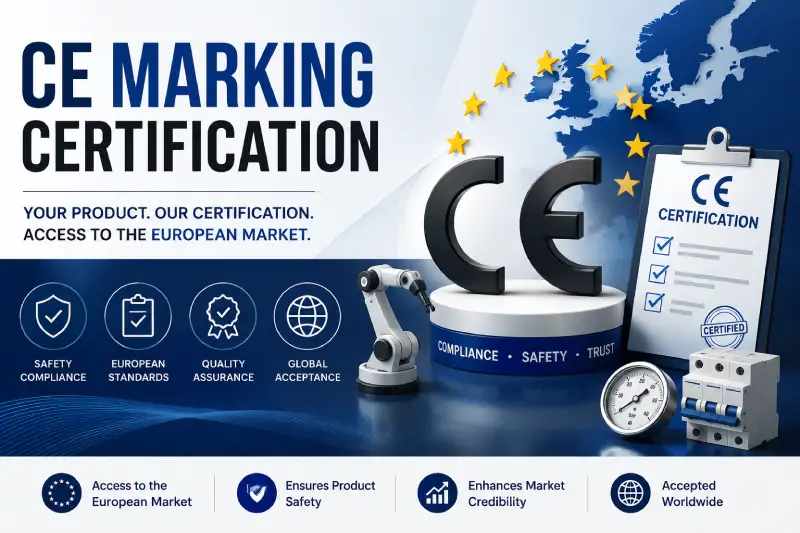
If your business manufactures products and you want to sell them in Europe, you’ve almost certainly come across two letters that carry enormous weight: CE.
CE marking certification is the mandatory compliance requirement for hundreds of product categories entering the European Economic Area (EEA). Without it, your product simply cannot be legally sold in one of the world’s largest and most lucrative consumer markets – 27 EU member states plus Norway, Iceland, and Liechtenstein, covering over 450 million consumers.
For Indian exporters and manufacturers, understanding CE marking is not optional. It’s the difference between accessing the European market and being locked out of it entirely. Yet for many businesses, the process feels confusing – multiple directives, technical documentation, conformity assessments, notified bodies. Where do you even start?
This guide cuts through the complexity. Q Matrix Consultancy Services has been helping Indian manufacturers and exporters obtain CE marking certification for over 14 years – guiding businesses from Kolkata to Kerala, Delhi to Pune, through every step of the process. Here’s everything you need to know.
What is CE Marking Certification?
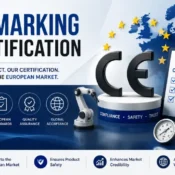
CE marking – where CE stands for ‘Conformité Européenne’ (French for ‘European Conformity’) – is a mandatory product certification mark that indicates a product meets the health, safety, and environmental protection standards required by European Union legislation.
When a manufacturer or importer affixes the CE mark to a product, they are making a legal declaration that the product complies with all applicable EU directives and regulations. It is not a quality mark or a seal of approval from a testing body – it is a declaration of conformity with European law.
The CE mark is not a ‘Made in Europe’ label. Products manufactured anywhere in the world –
including India – can carry the CE mark, provided they meet EU requirements.
For Indian exporters, this is the gateway to selling in Europe legally.
The CE mark allows products to move freely across all EEA member states without requiring separate national approvals in each country. Once a product is CE marked, it can be sold anywhere in the European Economic Area – making it one of the most valuable product certifications an Indian exporter can hold.
Which Products Require CE Marking?
CE marking is not required for every product – it applies specifically to product categories covered by EU directives and regulations. Q Matrix provides CE marking support across all major EU directives, including:
- Low Voltage Directive (LVD) – Electrical equipment operating between 50–1000V AC or 75–1500V DC
- Machinery Directive (MD) – Industrial machinery, machine tools, and equipment
- Electromagnetic Compatibility (EMC) – All electrical/electronic equipment that may cause or be affected by electromagnetic interference
- Radio Equipment Directive (RED) – Wireless devices, radio transmitters, Wi-Fi products, Bluetooth devices
- Medical Devices Directive (MDD) – Medical equipment and devices
- In-Vitro Diagnostic Medical Devices – Laboratory diagnostic equipment and test kits
- Personal Protective Equipment (PPE) – Safety helmets, gloves, protective clothing
- Construction Products Regulation (CPR) – Building and construction materials
- Measuring Instruments Directive (MID) – Meters, weighing instruments, measuring devices
- Gas Appliances Regulation (GAR) – Gas cooking appliances, heating equipment
- Pressure Equipment Directive (PED) – Pressure vessels, boilers, piping systems
- Toy Safety Directive – Children’s toys and play equipment
- Chemical Substances (REACH) – Products containing chemicals subject to EU REACH regulation
- Restriction of Hazardous Substances (RoHS) – Electrical and electronic equipment with substance restrictions
- General Product Safety Directive – Products not covered by specific directives
Important: A single product may fall under MULTIPLE directives simultaneously.
For example, a wireless power tool may need to comply with the Machinery Directive,
EMC Directive, and Radio Equipment Directive at the same time.
Q Matrix conducts a full directive identification assessment for every product we handle.
How Does CE Marking Certification Work?
CE marking is achieved through a process called conformity assessment – verifying that your product meets all applicable EU requirements. The exact process depends on which directive applies and the risk level of your product.
Step 1 – Identify Applicable Directives
Before anything else, you need to know which EU directives and regulations apply to your specific product. This is not always straightforward – a product can fall under multiple directives, each with its own requirements. Q Matrix handles this identification as the first step of every engagement.
Step 2 – Review Essential Requirements
Each EU directive sets out ‘essential requirements’ – the mandatory health, safety, and performance standards your product must meet. These are detailed technical requirements that your product’s design and manufacturing process must satisfy.
Step 3 – Product Testing
Your product must be tested against the applicable EU harmonised standards. Testing can be done by an accredited laboratory – either internally (if you have the capability) or by an independent testing body. For higher-risk products, testing by a Notified Body is mandatory.
Step 4 – Notified Body Involvement (Where Required)
For certain high-risk product categories – medical devices, pressure equipment, PPE, and others – a Notified Body (an independent third-party organisation accredited by an EU member state) must be involved in the conformity assessment. They review your technical documentation, test results, and quality systems before CE marking can proceed.
Step 5 – Compile Technical Documentation
You must prepare and maintain a Technical File – a comprehensive set of documents that demonstrates your product’s compliance. This includes product descriptions, design drawings, risk assessments, test reports, applicable standards, and the Declaration of Conformity.
Step 6 – Sign the Declaration of Conformity
The manufacturer (or their authorised representative in the EU) signs a Declaration of Conformity – a legal document stating that the product meets all applicable EU requirements. This document must be available to EU market surveillance authorities on request.
Step 7 – Affix the CE Mark
Once all requirements are met, the CE mark is affixed to the product. For products requiring Notified Body involvement, the four-digit Notified Body identification number is added alongside the CE logo. The product can now be legally placed on the European market.
CE Marking vs UKCA Marking – What Indian Exporters Need to Know Post-Brexit
Since the United Kingdom left the European Union, two separate marks now exist for two separate markets:
CE Marking – For the European Economic Area (EEA)
CE marking remains the requirement for selling products in EU member states plus Norway, Iceland, and Liechtenstein. If Europe is your target market, CE marking is what you need.
UKCA Marking – For Great Britain (England, Scotland, Wales)
Following Brexit, Great Britain introduced its own product marking – the UKCA (UK Conformity Assessed) mark. Products sold in Great Britain now require UKCA marking instead of (or in addition to) CE marking. Northern Ireland continues to accept CE marking under the Windsor Framework.
Q Matrix provides support for both CE marking (EU) and UKCA marking (Great Britain).
If your products are sold in both markets, we can manage both compliance programmes
simultaneously – reducing duplication and keeping your market access comprehensive.
Why CE Marking Matters for Indian Manufacturers
Legal market access – no CE mark, no entry
This is non-negotiable. Products in regulated categories without CE marking cannot be legally imported, distributed, or sold anywhere in the EEA. Customs authorities can – and do – seize non-compliant products at the border. The cost of seized shipments, rejected consignments, and delayed market entry far exceeds the cost of proper CE marking from the start.
India’s export ambitions make CE marking more critical than ever
Europe is one of India’s largest trading partners. As Indian manufacturers increasingly look to export – in sectors like engineering goods, electronics, medical devices, machinery, chemicals, and consumer products – CE marking is the first compliance hurdle they encounter. Getting it right opens a market of 450+ million consumers.
It signals quality to European buyers
While CE marking is a legal requirement rather than a quality award, European buyers treat it as a baseline signal of seriousness and reliability. Manufacturers who have gone through proper CE marking conformity assessment have demonstrated that their products meet rigorous technical standards – and buyers know it.
It protects your business from liability
If a CE-marked product causes harm in the European market, the manufacturer is liable. Getting CE marking right – with proper testing, documentation, and conformity assessment – is also your legal protection. Corners cut in the CE marking process can result in product recalls, fines, and legal action in EU jurisdictions.
Common CE Marking Mistakes Indian Exporters Make
In our 14 years of supporting CE marking projects, Q Matrix has seen the same mistakes come up repeatedly – and they are almost always avoidable:
- Assuming one directive covers the whole product – many products fall under multiple directives simultaneously
- Using outdated harmonised standards – EU standards are revised regularly; using a withdrawn standard means your compliance is invalid
- Incomplete Technical Files – missing risk assessments, insufficient test documentation, or poorly drafted Declarations of Conformity
- Self-declaring CE marking when a Notified Body is required – for high-risk categories, self-certification is not legally permitted
- Not updating CE marking when the product changes – any significant design or component change may require a new conformity assessment
- Confusing CE marking with ISO certification – they are completely separate requirements serving different purposes
Each of these mistakes can result in products being removed from the European market, fines, and reputational damage with European distributors and buyers. Working with an experienced CE marking consultant from the start is almost always less expensive than fixing problems after the fact.
Why Choose Q Matrix for CE Marking Certification?
Q Matrix Consultancy Services has been supporting Indian manufacturers with CE marking and product certification for over 14 years. Here’s what makes our approach different:
- Complete directive identification – we identify every applicable EU directive for your specific product, so nothing is missed
- End-to-end support – from initial assessment and testing coordination to Technical File preparation and Declaration of Conformity drafting
- Notified Body coordination – we work with accredited Notified Bodies for products requiring third-party conformity assessment
- UKCA marking support – we handle both CE and UKCA simultaneously for exporters targeting both EU and UK markets
- Pan-India presence – supporting manufacturers across all Indian states, in-person and remotely
- Complementary certification expertise – CE marking often needs to work alongside ISO 9001, ISO 13485 (Medical Devices), or RoHS compliance. Q Matrix handles all of these under one roof
- 14+ years of experience – with a proven track record across engineering, electronics, medical devices, machinery, consumer products, and more
Frequently Asked Questions About CE Marking Certification
Q1. Is CE marking mandatory for all products exported to Europe from India?
CE marking is mandatory for products that fall within the scope of EU directives and regulations – not for every product category. If your product falls under one or more EU directives (such as the Low Voltage Directive, Machinery Directive, EMC, Medical Devices, etc.), CE marking is legally required before you can sell in the EEA. Products outside the scope of any EU directive – such as clothing, furniture, and most food products – do not require CE marking, though other regulations may apply. The first step is always to identify whether your specific product falls under any EU directive, which Q Matrix can assess for you.
Q2. Can an Indian manufacturer self-certify CE marking, or is a third party required?
It depends on the product and the applicable directive. For many product categories – such as general machinery, low-voltage electrical equipment, and EMC – manufacturers can self-certify through an internal conformity assessment, provided they have the technical capability and documentation. However, for higher-risk categories – including medical devices, PPE Category III, pressure equipment, and lifts – EU legislation requires involvement of a Notified Body (an accredited independent third party) as part of the conformity assessment. Q Matrix will identify whether your product requires Notified Body involvement and coordinate that process if needed.
Q3. How long does CE marking certification take in India?
The timeline varies significantly depending on the product type, number of applicable directives, and whether Notified Body involvement is required. For relatively straightforward products, the process can take 4 to 8 weeks. For complex products – such as medical devices or pressure equipment requiring Notified Body assessment – the process can take 3 to 6 months or longer. Q Matrix provides a realistic timeline estimate after an initial product assessment, and we work efficiently to keep your project on track without cutting corners on technical requirements.
Q4. What is a Technical File and why is it important for CE marking?
The Technical File (also called Technical Documentation) is the comprehensive set of documents that demonstrates your product’s compliance with all applicable EU directives. It must include a product description and specifications, design drawings and schematics, risk assessment results, applicable harmonised standards, test reports and results, the Declaration of Conformity, and – where applicable – quality system documentation. The Technical File must be maintained and made available to EU market surveillance authorities for up to 10 years after the last product is placed on the market. A poorly prepared Technical File is one of the most common reasons CE marking is challenged or rejected. Q Matrix prepares complete, audit-ready Technical Files as part of our standard CE marking service.
Q5. Does CE marking need to be renewed, and what happens if our product design changes?
CE marking does not have a fixed renewal date – it remains valid as long as the product and its compliance status remain unchanged. However, if you make a significant change to your product’s design, components, materials, or intended use, you are required to conduct a new conformity assessment and update your Technical File and Declaration of Conformity accordingly. The same applies if the EU harmonised standards your product was assessed against are revised or withdrawn. Q Matrix recommends periodic compliance reviews – particularly when product changes are planned or when EU standards are updated – to ensure your CE marking remains valid and your products stay legally compliant in the European market.
Ready to Access the European Market?
CE marking certification is not just a regulatory hurdle – it’s your ticket to one of the world’s most valuable markets. Getting it right the first time saves time, money, and the risk of having products turned away at European borders. Q Matrix Consultancy Services brings 14 years of CE marking expertise, pan-India coverage, and a genuine commitment to your export success. Whether you’re approaching CE marking for the first time or need to update existing compliance for a product change, we’re ready to help.